
The short answer
Rest, sip fluids constantly (oral rehydration solution, not sports drinks), eat plain food when you can, be careful with anti-diarrhoeal tablets, and see a doctor for blood, a fever, severe pain, signs of dehydration, or anything that is not improving after a few days.
That is healthdirect's self-care list and its when-to-see-a-doctor list, compressed. Below is the same advice at full length, plus the two questions people search at 3am: whether to take the tablets, and whether the drip is worth it.
If you are travelling with a child or an older person, read the dehydration section first. They get worse faster, and the rules on medicines are different for children.
The first 24 hours
healthdirect's self-care list for diarrhoea is short and worth following exactly: rest; drink clear fluids or oral rehydration solution to replace what you are losing, in small sips if you feel sick; avoid alcohol and caffeine; avoid artificial sweeteners, which can prolong diarrhoea; and eat bland food such as rice, pasta and crackers while avoiding fatty foods and anything high in insoluble fibre.
The Victorian Department of Health adds two things: dairy can make diarrhoea worse in some people, so go easy on it, and spicy food and alcohol are off the menu until you are better. Cancel the day. A villa with a pool is a fine place to be ill, and the island will still be there tomorrow.
Hydration: why the sachets beat the sports drink
Diarrhoea loses water and salts together, and healthdirect is specific that oral rehydration solutions are better than plain water for children and older people because they contain the right concentration of salts to replace both. It says plainly that sports rehydration drinks are not recommended, and its dehydration page lists soft drinks and sports drinks among the sugary drinks to avoid.
Oral rehydration sachets are sold in Australian pharmacies and supermarkets, and in Bali pharmacies (look for 'apotek'). Packing a few from home is the whole reason the medical kit page exists. Signs you are getting dehydrated, from healthdirect: thirst, a dry mouth, headache, feeling dizzy or light-headed when you stand, and passing less urine. Its urine colour chart is the simplest check.
Adults
Small sips, constantly. Oral rehydration solution if you can get it, clear fluids if you cannot. No alcohol, coffee or soft drink.
Children
Oral rehydration solution rather than water. Fewer wet nappies, or a child who is not going to the toilet as often, is the early warning. Babies under six months with any sign of dehydration: see a doctor as soon as possible.
The tablets: anti-diarrhoeals and antibiotics
This is the question people search most, so here is healthdirect's rule on over-the-counter anti-diarrhoeal medicines, unchanged:
Check with your pharmacist or doctor if you are thinking of taking over-the-counter anti-diarrhoeal medicines. These are not suitable for use in all cases of diarrhoea. Do not take them if you have a fever or have blood in your stool.
Two more lines from the same page: anti-diarrhoeals should not be used to treat diarrhoea in children, and they should not be taken long term because they slow the gut and can prolong the illness. The Victorian fact sheet gives the reason to skip them with a high fever: holding a bacterial infection and its toxins inside for longer is not a win. So a loperamide product is a tool for the flight home or a long drive, taken with a pharmacist's nod, not a cure and never for kids.
Antibiotics are a doctor's decision. healthdirect says you may need them if a stool sample shows a bacterial cause, and the Victorian sheet says different bugs need different medicines, which is why a stool test matters when it drags on. Buying antibiotics over the counter in Bali is not the move; Smartraveller notes that buying prescription-only medicine without an Indonesian prescription is illegal there. Before you go, healthdirect does suggest one conversation:
Ask your doctor about bringing a course of antibiotics in case you get gastroenteritis (infection of your bowels) and aren't able to access medical care.
When to see a doctor, and when to go now
healthdirect's list for seeking medical advice: diarrhoea that is ongoing, blood or mucus in your stool, a fever, unexplained weight loss, or diarrhoea at night. Its list for urgent care, meaning a doctor immediately or the nearest emergency department: severe diarrhoea, signs of dehydration (feeling tired, decreased urination, thirst and dry mouth), heavy rectal bleeding, or diarrhoea with severe abdominal pain.
Smartraveller's Indonesia page adds its own trigger: seek medical attention if you suspect food poisoning, have a fever or diarrhoea. Between the two, the working rule is simple. A rough day or two with fluids going in and staying down: self-care. Blood, fever, real pain, fluids not staying down, a child or older person fading, or day three with no improvement: a clinic, today.
Where to go in Bali
Our guide's gotchas chapter has the practical bit: 112 is Indonesia's general emergency number, international-standard clinics such as BIMC and Siloam are in Kuta, Denpasar, Ubud and Nusa Dua, and your travel insurer's 24-hour line is on your policy. Call the insurer early; many will direct you to a clinic they work with and handle the paperwork.
Set expectations honestly. Smartraveller says this about medical care in Indonesia:
The standard of medical facilities, including for critical care of seriously ill patients, is generally lower than in Australia, including in Bali. Many regional hospitals only provide basic facilities.
It also warns that hospitals will expect a family member or friend to guarantee payment before treating you, generally with confirmation of insurance and a deposit, and that there is no reciprocal healthcare agreement between Australia and Indonesia. Tourists pay for everything. This is the paragraph that makes the insurance PDS worth reading before you fly, not after.
The IV drip question
Bali has a whole industry of clinics and mobile services offering an intravenous drip for Bali belly, and people search whether it is worth it. healthdirect's position on IV fluids is narrow: they are for when you are not able to take in enough fluids by mouth. If you can sip and keep it down, oral rehydration solution does the same job without a cannula. If you cannot, that is one of the urgent-care signs above and a clinic should be assessing you anyway, not just hydrating you.
We have no data on any particular drip service and will not recommend one. What we can say is that the decision belongs to a doctor looking at you, and that 'fluids not staying down' is the line.
Flying home, and afterwards
healthdirect's rule for going back to work or school is 48 hours after the last episode of vomiting or diarrhoea, and it is a sensible bar for a flight too. If your departure lands inside that window, a loperamide product with a pharmacist's advice is what it exists for; a doctor's letter helps if you need to move the flight and claim it.
Smartraveller says to get medical advice if you feel unwell overseas or when you get back to Australia, and healthdirect notes that ongoing diarrhoea, or dairy disagreeing with you for a couple of weeks afterwards, are both worth a GP visit. Parasitic causes in particular can drag on and need a test.
Questions from the bathroom floor
Should I take Gastro-Stop for Bali belly?
What should I eat with Bali belly?
Do I need antibiotics for Bali belly?
When should I go to a clinic?
How do I know I am dehydrated?
Is an IV drip worth it for Bali belly?
Can I fly with Bali belly?
What is the emergency number in Bali?
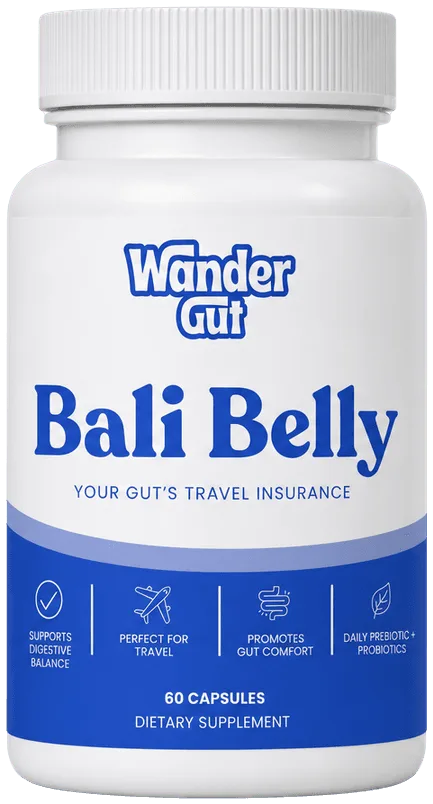
Bali Belly: the travel probiotic made for Bali and beyond
Your travel companion: 60 billion CFU, five strains plus a prebiotic, shelf-stable so it needs no fridge and lives in the day pack. Two capsules a day, from about a week before you fly and every day you are away. Suitable for adults and children over 3.
- 60 billion CFU
- 5 strains plus a prebiotic
- No fridge needed
- Ships from Australia
Always read the label and follow directions for use. Everything on this site is free and stays free: the guide, the tools, the checklists. The shop is what pays for it.
Sources and dates
- healthdirect, Diarrhoea, last reviewed February 2024. Read 13 September 2026.
- healthdirect, Dehydration, last reviewed July 2024. Read 13 September 2026.
- healthdirect, Gastroenteritis, last reviewed November 2025. Read 13 September 2026.
- healthdirect, Travel health advice, last reviewed December 2025. Read 13 September 2026.
- Smartraveller, Indonesia travel advice, updated 11 September 2026, still current on the day we read it. Read 13 September 2026.
- Better Health Channel (Victorian Department of Health), Traveller's diarrhoea, the page states it was reviewed 31 July 2013; used for the causes and the risk-food list, which the newer sources repeat. Read 13 September 2026.
- The Wander Gut Bali guide, chapters on food, getting around, etiquette and gotchas, verified July 2026. Read 13 September 2026.
Left out on purpose because we could not verify it from a primary source: clinic and drip prices; the names of specific medicines beyond the classes the government sources use; how long a particular clinic's wait is.