
The short answer
Bali belly is traveller's diarrhoea: an infection picked up from contaminated food or water, most often bacterial, sometimes viral or parasitic, that usually clears in a few days on its own.
The Victorian Department of Health's fact sheet lists the usual suspects: bacteria such as enterotoxigenic E. coli (one of the most common causes), Campylobacter, Salmonella and Shigella; viruses such as norovirus and rotavirus in roughly one case in three; and parasites such as Giardia in the cases that drag on. In somewhere between a fifth and a half of cases no cause is ever found.
Why visitors and not locals? The same source's explanation is acquired immunity: the micro-organisms that make a traveller ill appear harmless to the people who grew up with them. Which is why the habits page matters more than any tablet.
What Bali belly actually is
Traveller's diarrhoea is the medical name, and the Victorian Department of Health's fact sheet lists Bali belly alongside Montezuma's revenge and the Rangoon runs as other names for the same thing. The symptoms it lists are abdominal bloating, cramps and pain, nausea, urgency, loose watery stools passed frequently, a mild temperature, and general malaise.
healthdirect's definition of diarrhoea is three or more loose or liquid stools in a day, or more often than is normal for you, and it notes the extras that can come with it: nausea and vomiting, fever, headache, bloating, wind, tummy pain and loss of appetite. If that reads like the worst day of your last trip, that is the illness.
The bugs behind it
Four groups, from the Victorian fact sheet, in rough order of how often they turn up:
Bacteria
Enterotoxigenic E. coli (ETEC) is one of the most common bacterial causes. Campylobacter, Salmonella and Shigella also appear, and those are the ones usually associated with severe pain and fever.
Viruses
Norovirus and rotavirus. Some estimates put viral infection behind or alongside about one case in three.
Parasites
Giardia, Entamoeba and Cryptosporidium. These cases last longer than a few days and the stools may be bloody, which is a reason to see a doctor.
Unknown
In roughly a fifth to a half of cases no cause is found. The fact sheet suggests the gut may simply be reacting to unfamiliar micro-organisms.
Why you get it and the warung family does not
The Victorian fact sheet's explanation is acquired immunity: the micro-organisms that trigger the illness may appear harmless to the local population, presumably because local people have built immunity to them over a lifetime of exposure. You have not, so the same plate does different things to the two of you.
It also notes that traveller's diarrhoea is more common in young adults than older adults, probably because younger people pick more adventurous destinations and styles of travel, like backpacking. Nothing about Bali is uniquely dangerous; it is simply the place a very large number of Australians go and eat adventurously.
Locals get it too, and the fact sheet never says otherwise. Its wording is careful: the organisms may appear harmless to the local population, presumably because of acquired immunity. That is a statement about odds, not a shield. healthdirect describes gastroenteritis as a common infection that spreads easily, and it names no group that is exempt. Balinese people get gastro, from the same bugs and the same bad batch of food, and Bali has its own public-health advice about it.
What a lifetime of exposure changes is your odds against the particular organisms you meet often, and even that is narrow. The same Victorian fact sheet is blunt about the limits of it: one bout buys you nothing against the next one, because so many different agents cause the same illness. So "the family running the warung is fine" is not evidence that the food is fine. It is evidence that they have met those bugs before, which you have not, and which will still be true on your second trip.
How it gets into you
Food and water, in that order. The Victorian fact sheet calls contaminated food a major cause and water contaminated with infected faeces another common one. healthdirect adds the route people forget: gastroenteritis also spreads person to person, through contact with someone who is ill and through contaminated objects, which is why hand washing keeps coming up.
On timing, healthdirect's gastroenteritis page says food poisoning symptoms usually begin 6 to 12 hours after eating spoiled food, and the Victorian sheet says traveller's diarrhoea can occur at any time during the trip or even after you get home. So the meal you blame is often not the meal that did it.
How long Bali belly lasts
The Victorian fact sheet says it is usually self-limiting and tends to clear up in around four days. healthdirect's gastroenteritis page gives the shape of it: vomiting usually lasts 1 to 2 days, and diarrhoea usually around 1 to 3 days but can last up to 10.
Two things change the picture. Parasitic cases last longer than a few days and may be bloody; that needs a doctor and possibly a stool test, because different bugs need different treatment. And healthdirect notes some people develop a temporary lactose intolerance after a bout, so if dairy disagrees with you for a couple of weeks afterwards, that is why. See a doctor if it continues.
Is Bali belly contagious?
It can be. healthdirect describes gastroenteritis as highly infectious and mostly spread by contact with another person who has it, with the bugs found in faeces and vomit. Its rule for school and work is to stay away until 48 hours after the last episode of vomiting or diarrhoea, and to wash hands thoroughly after the bathroom and before food.
In a shared villa that means the unwell person gets their own towel, everyone washes hands before every meal, and nobody who is ill prepares food for the group. Sharing a bed or a kiss is contact; the autocomplete asks, and the honest answer is that anything that moves hand to mouth can move it.
Can you get it twice?
Yes. The Victorian fact sheet is explicit that one bout offers no protection against developing it again, because so many different infectious agents can cause it. A trip in June and another in December are two separate rolls of the dice, which is the argument for keeping the habits every time rather than treating a good first trip as immunity.
What it is not
healthdirect lists a change in diet, certain food ingredients, too much alcohol and stress among the ordinary causes of short-term diarrhoea. A new breakfast, a 1am arrival, heat and a few beers can produce a day that feels like Bali belly and is not an infection at all. It settles as you settle.
It is also not dengue, which is mosquito-borne and starts with fever and aches rather than the gut; the staying healthy page covers that. If you are unwell and unsure, the what-to-do page has the signs that mean a clinic, and a doctor is the person to decide.
The questions people search
Is Bali belly contagious?
How long does Bali belly last?
What bacteria causes Bali belly?
When does Bali belly start?
Can you get Bali belly from the pool or the sea?
Can you get Bali belly twice?
Is Bali belly the same as gastro?
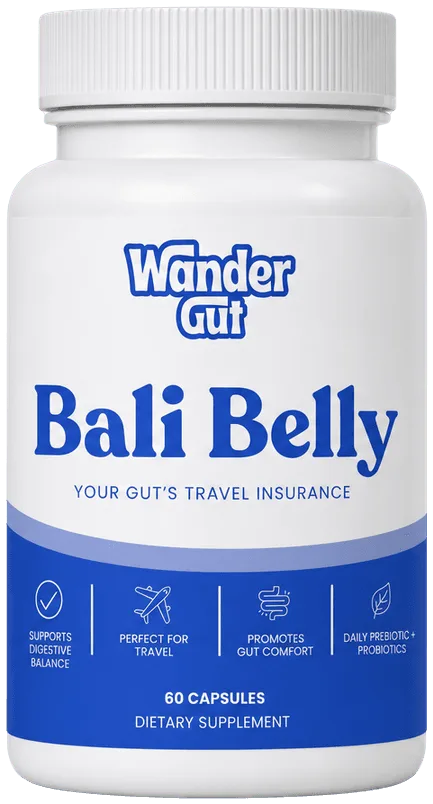
Bali Belly: the travel probiotic made for Bali and beyond
Your travel companion: 60 billion CFU, five strains plus a prebiotic, shelf-stable so it needs no fridge and lives in the day pack. Two capsules a day, from about a week before you fly and every day you are away. Suitable for adults and children over 3.
- 60 billion CFU
- 5 strains plus a prebiotic
- No fridge needed
- Ships from Australia
Always read the label and follow directions for use. Everything on this site is free and stays free: the guide, the tools, the checklists. The shop is what pays for it.
Sources and dates
- Better Health Channel (Victorian Department of Health), Traveller's diarrhoea, the page states it was reviewed 31 July 2013; used for the causes and the risk-food list, which the newer sources repeat. Read 13 September 2026.
- healthdirect, Gastroenteritis, last reviewed November 2025. Read 13 September 2026.
- healthdirect, Diarrhoea, last reviewed February 2024. Read 13 September 2026.
- The Australian Immunisation Handbook, Vaccination for international travellers. Read 13 September 2026.
- Smartraveller, Indonesia travel advice, updated 11 September 2026, still current on the day we read it. Read 13 September 2026.
Left out on purpose because we could not verify it from a primary source: how many visitors to Bali get it, because no primary Bali figure exists; which specific bacteria are most common in Bali itself, because the government sources describe traveller's diarrhoea in general, not Bali.