
The short answer
Bali belly is the nickname Australians give traveller's diarrhoea: a gut infection picked up from contaminated food or water. For most healthy adults it is unpleasant, boring and over in a few days without any treatment at all.
The important numbers, from healthdirect: diarrhoea means 3 or more loose or liquid stools in a day, it usually runs 1 to 3 days and can stretch to 10, and most cases clear on their own. What you are managing in the meantime is fluid, not the bug.
The parts worth knowing are the edges. Blood in the stool, a high fever, severe stomach pain or signs of dehydration are not a bad day, they are a reason to see a doctor, and Bali has plenty of them. Everything else on this page is detail underneath those two paragraphs.
What is Bali belly, actually?
Bali belly is not a medical diagnosis and you will not find it on a pathology report. It is an Australian nickname for traveller's diarrhoea, the same illness a Brit calls Delhi belly and an American calls Montezuma's revenge. The Better Health Channel describes it as something that happens to many people travelling from developed to developing countries, which is a polite way of saying your gut is meeting bacteria it has never had to deal with.
The clinical definition is narrower and more useful than the folklore, because it tells you when you actually have it rather than when you are simply off your food.
Diarrhoea is when you have 3 or more loose or liquid stools (poos) in one day, or more frequently than normal.
One bad stomach after a big night in Seminyak is not Bali belly. Three or more loose ones in a day, with cramps, is. The distinction matters because it changes what you do next: the first is a hangover and the second needs fluids and a bit of attention.
What causes Bali belly?
Contaminated food and water, and then a long list of organisms. The Better Health Channel names the usual suspects: bacteria including Escherichia coli (ETEC), Campylobacter jejuni, Salmonella and Shigella; parasites including Giardia, Entamoeba histolytica and Cryptosporidium; and viruses including norovirus and rotavirus.
Bacteria are the most common cause by a distance, which is why the illness usually behaves the way it does: a fast onset a day or two after the meal that did it, a few rough days, then over. Parasites are the slow ones and behave completely differently, which is covered on the parasite page.
The honest caveat, and one you will not often see on a clinic blog trying to sell you an IV drip:
A cause can't be found in approximately one-fifth to half of all cases.
So somewhere between a fifth and a half of the time, nobody ever finds out what it was. That is worth holding on to when you are lying in a villa mentally re-litigating every meal since the airport. Often there is no answer, and it does not change the treatment anyway.
How long does Bali belly last?
Short version: about one to three days for most people, up to ten at the outside. healthdirect gives the range for gastroenteritis generally, and it is the range travellers report.
Vomiting usually lasts 1 to 2 days. Diarrhoea usually lasts around 1 to 3 days but can last up to 10 days.
The Better Health Channel is slightly more specific for traveller's diarrhoea, describing it as a self-limiting condition that tends to clear up in around four days. Self-limiting means it stops on its own. You do not have to do anything clever to make that happen.
If you are past a week and still going, the shape of the illness has changed and it is worth reading how long Bali belly lasts, which goes day by day and covers the point where the timeline itself becomes the symptom.
What are the symptoms?
The Better Health Channel's list for traveller's diarrhoea: abdominal bloating, cramps and pain, nausea, urgency to go to the toilet, loose watery stools passed frequently, a mild temperature, and general malaise. Malaise is the medical word for feeling comprehensively terrible in a way you cannot point at.
Most of that is miserable rather than dangerous. The list that matters more is the short one, and healthdirect is direct about it. Seek medical attention for severe diarrhoea, signs of dehydration (feeling tired, passing less urine, thirst and a dry mouth), heavy rectal bleeding, or diarrhoea with severe abdominal pain. Blood or mucus in the stool, a fever, unexplained weight loss or diarrhoea that wakes you at night all warrant a doctor too.
Normal, and boring
Cramps, bloating, urgency, loose stools, a mild temperature, feeling wrung out. Annoying, self-limiting, manage the fluid.
See a doctor
Blood or mucus, a high fever, severe pain, not keeping fluids down, or signs of dehydration. Bali has good clinics and they are used to this.
Do not wait it out
A baby, a young child, an older traveller, or anyone pregnant or managing a condition. The thresholds are lower and the margin is smaller.
Still going after a week
The timeline itself is now the symptom. That is a stool test conversation, not a wait-and-see one.
The full symptom picture, including what separates it from ordinary food poisoning, is on the symptoms page.
What do you do when it starts?
Drink, rest, and stop planning the day you had planned. The single most useful thing is replacing fluid and salts, and healthdirect is specific that plain water is not the best tool for the job.
For older people and children, oral rehydration solutions are better than plain water. They contain the right concentration of salts to replace both fluids and electrolytes.
Oral rehydration sachets are sold in every Indonesian apotek and cost almost nothing, and they are the reason the chemist-bag list on the medical kit page puts them near the top. Mix with bottled or boiled water, not tap.
What not to reach for is the interesting part, because it contradicts what half of Australia believes:
Make sure you drink enough fluids so you don't get dehydrated. Sip clear fluids every 5 to 10 minutes. Try not to drink sugary drinks because they can make diarrhoea worse.
That one sentence is why the red cordial question gets its own page. On anti-diarrhoeal tablets such as loperamide, healthdirect's line is to check with your pharmacist or doctor first, and that they should not be used to treat diarrhoea in children.
Can you catch it from someone else?
Yes, depending on what it is. Bali belly is not itself contagious, because it is not a single thing, but several of the organisms behind it spread person to person very efficiently. Norovirus is the extreme case.
It is highly contagious. This means it spreads easily from person to person.
Which is why one person in a villa can become four in two days. The household rules are on the contagious page, and the short version is soap and water, not hand gel, and nobody who is unwell touches the shared food.
How do people lower their chances?
Nothing on earth makes you immune to a contaminated plate, and anyone selling you certainty is selling you something. What genuinely shifts the odds is dull and free: bottled or properly filtered water, including for brushing your teeth; ice only from busy established places; hot food from busy stalls where the turnover is high; fruit you peel yourself; and washing your hands properly before you eat, which in Bali means carrying soap because a lot of warung bathrooms do not have any.
That list is the whole of the honest advice, and it is expanded properly on how to avoid Bali belly. The water question in particular trips people up in ways they do not expect, which is why can you drink the water in Bali exists as its own page covering ice, teeth, showers and formula.
- Water: sealed bottled or properly filtered, for drinking and for your toothbrush.
- Ice: the cylindrical factory kind with a hole through it is the safer sort. When in doubt, order the drink without.
- Food: busy places, cooked hot in front of you, served hot. A quiet buffet under a heat lamp is the classic mistake.
- Fruit and salad: peel it yourself, or skip the raw leaves.
- Hands: soap and water before every meal. Carry your own soap.
Why do Australians call it Bali belly?
Because Australians go to Bali in numbers that make it worth having a nickname for. Bali is consistently among the top destinations for Australian short-term departures, and the figures are on our arrivals statistics page, taken straight from the ABS.
The nickname does the island a slight disservice. The same illness is the single most common health complaint of travellers everywhere in the region, and you can pick it up in Thailand, Vietnam or India just as easily. Bali simply happens to be where Australians go. It is also why the phrase turns up in the name of our own product, and that is as far as the connection goes: it is a name, not a promise.
The questions people actually search
What is Bali belly?
How long does Bali belly last?
Is Bali belly contagious?
What causes Bali belly?
What should I drink if I get Bali belly?
Is Bali belly the same as gastro?
Can you die from Bali belly?
Do probiotics help with Bali belly?
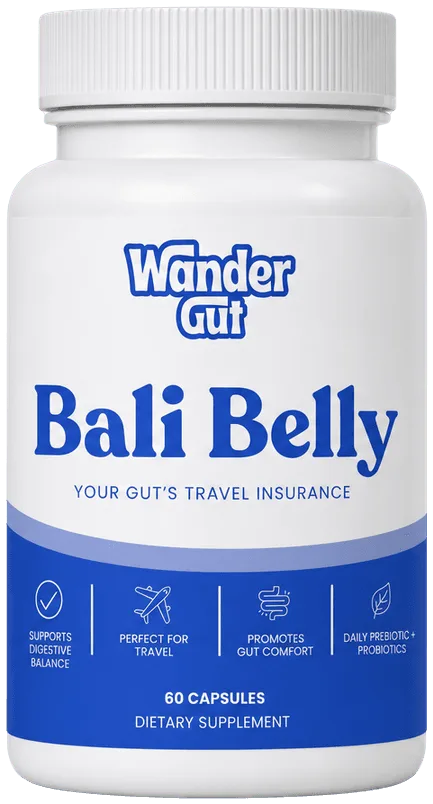
Bali Belly: the travel probiotic made for Bali and beyond
Your travel companion: 60 billion CFU, five strains plus a prebiotic, shelf-stable so it needs no fridge and lives in the day pack. Two capsules a day, from about a week before you fly and every day you are away. Suitable for adults and children over 3.
- 60 billion CFU
- 5 strains plus a prebiotic
- No fridge needed
- Ships from Australia
Always read the label and follow directions for use. Everything on this site is free and stays free: the guide, the tools, the checklists. The shop is what pays for it.
Sources and dates
- healthdirect, Diarrhoea: symptoms, causes, self care and treatments. Read 14 September 2026.
- healthdirect, Gastroenteritis. Read 14 September 2026.
- healthdirect, Norovirus infection. Read 14 September 2026.
- Better Health Channel (Victorian Department of Health), Travellers' diarrhoea. Read 14 September 2026.
- Smartraveller, Indonesia travel advice. Read 13 September 2026.
Left out on purpose because we could not verify it from a primary source: any figure for how many travellers get Bali belly, because the studies that exist measure traveller's diarrhoea across whole regions and none of them measures Bali; any claim that a supplement, a food or a drink changes your chances of getting it.