
The short answer
Drink sealed or properly boiled water and use it for your teeth, take ice only from established places, eat hot food cooked fresh in front of you, peel your own fruit, and wash your hands before every meal. That is the list.
Nothing on it is exotic, and the reason it works is in the causes page: the bugs behind Bali belly travel in contaminated food and water, so the habits that keep those out of your mouth are the habits that matter. The Australian Government's own list, quoted below, is four lines long.
The rest of this page is the practical version: how to handle ice without becoming the person who refuses every drink, which warungs are the good bet, what changes when you are travelling with kids, and the one honest answer about supplements.
What the Australian Government actually says
Two sources, same advice. Smartraveller's Indonesia page, in its health section, is blunt about why the habits matter:
Waterborne, foodborne, parasitic and other infectious diseases are widespread, and serious outbreaks occur.
Its list under that heading, read on 13 September 2026, is: boil drinking water or drink bottled water; avoid raw food, such as salads, and only eat meat from reputable suppliers; and seek medical attention if you suspect food poisoning or have a fever or diarrhoea. healthdirect, the government's health information service, puts it as four precautions for anywhere the tap water is not safe:
Water and ice: the rules, and the sensible middle
healthdirect's four lines are the rules. Here they are in its own words:
Where local tap water is not safe to drink, take these precautions: Only use bottled water to drink and brush your teeth. Don't put ice in your drinks. Only eat fruit you can peel. Avoid uncooked food, such as salads.
Water is the easy part. Sealed bottled water, or the refill dispensers that villas and cafés run from sealed 19-litre gallons, for drinking and for teeth. The water page covers boiling, hotels and kids' bottles in detail.
Ice is where the rule and real life part ways, because a week of warm drinks in Bali's heat is not how most people want to travel. The honest middle, which is also what our guide says, is that established venues buy factory ice, made from treated water and delivered in sealed bags, while a bucket of hand-chipped ice at a roadside stall is water you know nothing about. Take the ice at the beach club and the busy café; skip it at the stall.
What to eat, and where
The official risk-food list from the Victorian Department of Health is long: raw and peeled fruit and vegetables, leafy greens, undercooked meat, raw or poorly cooked seafood, sauces and mayonnaise, unpasteurised dairy, food from street vendors, hot food left to cool, and buffets. Follow all of it and you will eat toast for a week. The practical version, which every experienced Bali traveller ends up at, is about heat, freshness and turnover.
Our guide's line is the one to remember:
Good bet
Hot dishes cooked to order at a busy stall or warung, fruit you peel yourself, sealed drinks, factory ice at established venues.
Think twice
Raw salads and pre-cut fruit, sauces sitting out, buffets, anything hot that has gone cold, ice from a bucket.
Skip
Tap water, including for teeth; undercooked meat or seafood; unpasteurised dairy; free-pour spirits and arak, for a different reason (see the health page).
The habits worth keeping, however adventurous you get: sealed bottled water, busy stalls with hot fresh food, and wash your hands. Be mindful with ice from places you don't trust. Reputable cafés and bars use factory ice.
A busy warung is a good sign for exactly the reason the buffet is a bad one: food that sells out is food that was cooked recently. Point at what is being cooked hot in front of you, not what has been sitting in a tray under a lamp. Peel your own fruit. Go easy on raw salads and unpasteurised anything in the first few days, then decide for yourself.
Hands: the habit nobody rates and everybody needs
Every source on this page ends up at hand washing, because a lot of gastro is passed from hand to mouth rather than plate to mouth. healthdirect's gastroenteritis page says the infection spreads easily, including by person-to-person contact and through contaminated objects, and its first prevention line is washing your hands well after the bathroom and before handling food or eating.
In Bali that means soap and water when you can get it and a small bottle of sanitiser for when you cannot: after the money changer, after the scooter, after the monkey forest, before the nasi campur. The Victorian page adds a detail people miss: dry your hands properly before you touch food.
Travelling with kids
Children get dehydrated faster than adults when they are unwell, which is why the sources treat them separately. The Victorian Department of Health's list for children is practical: keep small children off the floor, keep unwashed fingers out of mouths, wash their hands often, and make up formula with bottled water or tap water boiled for at least five minutes.
Add the obvious: a child will drink the pool and the bath, so use the sealed bottle for teeth and keep mouths closed in the pool as best you can. Pack oral rehydration sachets from home (see the medical kit page) so you are not looking for them at 2am.
The first three days feel like Bali belly and usually are not
A long flight, a 1am arrival, heat, a different breakfast and a few Bintangs will unsettle most stomachs, and healthdirect lists a change in diet and alcohol among the ordinary causes of short-term diarrhoea. That is not an infection and it settles as you do. Drink more water than feels necessary, eat something plain, and sleep.
The what-to-do page has the signs that separate an unsettled stomach from something a clinic should see: blood, a fever, pain that is getting worse, or not being able to keep fluids down.
Tablets, supplements and the honest answer
The autocomplete for this topic is full of 'tablets' and 'medicine', so here is the straight version. The Victorian Department of Health's page says there is no vaccine that reliably keeps traveller's diarrhoea away and that the best defence is the habits above. Whether any medicine is worth carrying for a trip is a conversation for your GP or a travel clinic, and healthdirect's own suggestion on that is quoted on the medical kit page.
We sell a travel probiotic, so we will say this plainly: no supplement can honestly promise you will not get Bali belly, ours included, and our own product FAQ says so in one word. A daily probiotic is a routine some travellers keep; the routine page explains what it is for and what it is not. The habits on this page are the part that changes your odds.
The questions people ask before they fly
Can you drink the water in Bali?
Is the ice safe in Bali?
Is street food safe in Bali?
Can I brush my teeth with tap water in Bali?
How do I avoid Bali belly with kids?
Can you get Bali belly twice?
Do probiotics help with Bali belly?
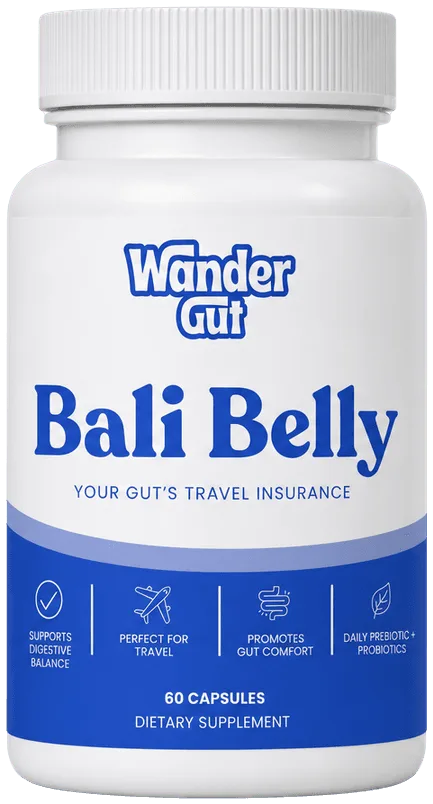
Bali Belly: the travel probiotic made for Bali and beyond
Your travel companion: 60 billion CFU, five strains plus a prebiotic, shelf-stable so it needs no fridge and lives in the day pack. Two capsules a day, from about a week before you fly and every day you are away. Suitable for adults and children over 3.
- 60 billion CFU
- 5 strains plus a prebiotic
- No fridge needed
- Ships from Australia
Always read the label and follow directions for use. Everything on this site is free and stays free: the guide, the tools, the checklists. The shop is what pays for it.
Sources and dates
- Smartraveller, Indonesia travel advice, updated 11 September 2026, still current on the day we read it. Read 13 September 2026.
- healthdirect, Travel health advice, last reviewed December 2025. Read 13 September 2026.
- healthdirect, Gastroenteritis, last reviewed November 2025. Read 13 September 2026.
- healthdirect, Diarrhoea, last reviewed February 2024. Read 13 September 2026.
- Better Health Channel (Victorian Department of Health), Traveller's diarrhoea, the page states it was reviewed 31 July 2013; used for the causes and the risk-food list, which the newer sources repeat. Read 13 September 2026.
- The Australian Immunisation Handbook, Vaccination for international travellers. Read 13 September 2026.
- The Wander Gut Bali guide, chapters on food, getting around, etiquette and gotchas, verified July 2026. Read 13 September 2026.
Left out on purpose because we could not verify it from a primary source: any percentage of visitors who get Bali belly, because no primary Bali figure exists; which areas or restaurants are safer, because there is no data.