
The short answer
Repellent and long light clothing against day-biting mosquitoes, SPF 30+ reapplied and a hat, no touching dogs or monkeys, only sealed branded drinks, a helmet and a licence or no scooter, swim between the flags, and travel insurance that covers all of it.
Smartraveller's current advice level for Indonesia is 'exercise a high degree of caution', updated 11 September 2026, and its health section lists insect-borne illness, food- and water-borne illness, rabies, methanol and medical care standards as the things to know. healthdirect fills in the practical detail on dengue, rabies first aid and sun.
The gut side (food, water, ice, what to do if it goes wrong) has its own pages, linked at the bottom. This one is everything else.
Mosquitoes: dengue is the one to take seriously
Smartraveller lists dengue, Zika, malaria, Japanese encephalitis and filariasis as insect-borne illnesses present in Indonesia year-round, and adds a Bali-specific line:
Australian health authorities have reported Dengue and Japanese encephalitis have been present in people returning from Indonesia, including from popular tourist regions such as Bali.
healthdirect's dengue page has the two facts that change behaviour. First, the mosquitoes that spread dengue bite throughout the day, most actively in the hours after sunrise and before sunset, so this is not a night-time-only problem. Second, there is no vaccine for a first dengue infection, so the whole game is not getting bitten: repellent containing DEET, picaridin or oil of lemon eucalyptus on exposed skin, loose long light-coloured clothing, socks and closed shoes, screens or air-conditioning at night.
Symptoms appear 4 to 10 days after the bite and most people recover in about a week, but healthdirect says to speak to a doctor right away if you have symptoms, and to reduce fever with paracetamol, not aspirin or ibuprofen, which can increase bleeding risk with dengue. Severe dengue is rare and needs urgent care. Malaria is a doctor conversation before you go; Smartraveller's general health page suggests asking about preventive medicines.
Sun and heat
Bali sits eight degrees south of the equator and the UV is strong all year, in a way the temperature does not always warn you about. healthdirect's rule is sun protection whenever the UV index is 3 or higher, which in the tropics is most of every day: broad-spectrum, water-resistant SPF 30+ sunscreen reapplied often, a hat that covers face, neck and ears, sunglasses that meet Australian standards, and clothing that covers as much skin as you can bear. It notes that water, thin cloud and light sand increase exposure, which describes a Bali beach exactly.
Heat is the quieter problem. Long flights, alcohol and a pool day dehydrate you before you notice, and dehydration looks like a headache, dizziness on standing and dark urine. Drink more water than feels necessary, and pack electrolyte sachets for the hot days; the packing list has them for a reason. Reef-safe sunscreen is expensive on the island, so bring it.
Dogs, monkeys, cats and bats: rabies
This is the section people skip and should not. Smartraveller:
Rabies is throughout Indonesia. It's 100% fatal and is mainly transmitted by dogs, cats, monkeys and bats, but can be transmitted by all land mammals.
Its advice is to consider vaccination before travel, avoid direct contact with animals even in places where you are encouraged to interact with them, and get urgent medical care for any bite or scratch. It warns that rabies treatment may be limited and the vaccine is not available everywhere, so a bite can mean flying home or to another country for treatment.
healthdirect's first aid after any animal bite or scratch overseas: wash the wound with soap and water for 15 minutes straight away, apply an iodine-containing antiseptic, and see a doctor as soon as you can, even if you have had the rabies vaccine. Its behaviour rules are the ones for the monkey forest: do not carry food, do not feed or pat monkeys, and try not to stare at monkeys with babies, which can bite suddenly. Do not touch stray dogs or cats. Whether you should have the vaccine before you go is your doctor's call; the vaccinations page has what the sources say.
Drinks: methanol and spiking
The single most serious paragraph on Smartraveller's Indonesia page, unchanged:
People have died or become very sick from poisoned drinks overseas. This includes Australians. Methanol is highly toxic. As little as one shot can be fatal. Methanol can be added or accidentally created during poor quality alcohol production. Only drink branded, sealed drinks. Get urgent medical help if you think you've been poisoned.
Its list of contaminated drinks includes local spirits such as arak and spirit-based cocktails, and it says symptoms can be similar to drinking too much, only stronger. Our guide's rule is the same in fewer words: sealed, branded drinks from licensed venues; skip free-pour spirits and street arak; methanol has no taste or smell; if unsure, do not finish it. Smartraveller also reports drink spiking in Bali and Lombok: watch your drink being made, do not leave it, and stay with a friend who feels suddenly unwell.
Scooters and roads
Smartraveller reports that Australians have been seriously injured and died in motorcycle and moped accidents, including in tourist areas, particularly Bali, Lombok and the Gili Islands. Its rules: you need an Indonesian licence or an International Driving Permit in addition to your Australian licence, the permit has to cover the vehicle type (so motorcycle class for a scooter), always wear a helmet, and check whether your insurance excludes you if you are not licensed to ride at home.
Our guide says the quiet part: a car licence with an IDP does not cover a scooter, police checkpoints in Canggu and Seminyak are routine, and riding unlicensed usually voids your travel insurance. If that sounds like a lot, that is what ride apps are for. The getting around page has the whole picture.
The sea, rips and boats
Smartraveller says Australians have drowned due to rough seas and strong rip currents at popular beaches including in Bali, that rip currents cause the drownings of several Australians each year, and that conditions change rapidly. Swim between the flags where there are flags, and ask locals where there are not; the Bukit's cliff beaches are beautiful and unforgiving.
Boats to the Nusa islands and the Gilis are the other one. Smartraveller lists a run of incidents: a boat that sank travelling to Padang Bai from Gili Trawangan in March 2026 with 117 rescued, a fast boat that capsized in Sanur Harbour in August 2025, and others. Its advice: check the boat has life jackets, safety and communication equipment, check the sea and weather forecast, and delay if conditions are not safe. Pick the operator with the safety gear, not the cheapest ticket.
The rest of the list
- Food and water. The gut pages: the habits, the water question, what to do if it happens.
- Magic mushrooms. Illegal, and Smartraveller says Australians have become sick, injured and arrested after taking them, particularly in Bali.
- Black henna tattoos. Smartraveller says the dye often causes serious skin reactions. Check hygiene before any tattoo.
- Volcanoes. Agung and Batur are active; follow exclusion zones, and know that eruptions can close the airport at short notice.
- Medical care. Smartraveller says standards are generally lower than in Australia, including in Bali, that tourists pay for everything, and that hospitals expect a payment guarantee before treatment. 112 is the emergency number; international-standard clinics are in Kuta, Denpasar, Ubud and Nusa Dua.
- Insurance. Smartraveller's line is that if you cannot afford travel insurance, you should not travel. Read the PDS for scooters, diving and evacuation, and carry the 24-hour number offline.
The questions people ask
Is there dengue in Bali?
Do I need the rabies vaccine for Bali?
What insect repellent works in Bali?
Is it safe to swim in Bali?
Is Bali safe right now?
What is the emergency number in Bali?
Should I take paracetamol or ibuprofen for a fever in Bali?
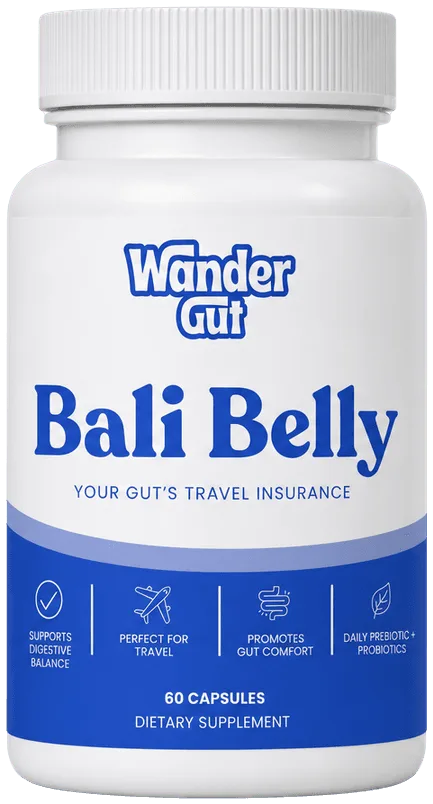
Bali Belly: the travel probiotic made for Bali and beyond
Your travel companion: 60 billion CFU, five strains plus a prebiotic, shelf-stable so it needs no fridge and lives in the day pack. Two capsules a day, from about a week before you fly and every day you are away. Suitable for adults and children over 3.
- 60 billion CFU
- 5 strains plus a prebiotic
- No fridge needed
- Ships from Australia
Always read the label and follow directions for use. Everything on this site is free and stays free: the guide, the tools, the checklists. The shop is what pays for it.
Sources and dates
- Smartraveller, Indonesia travel advice, updated 11 September 2026, still current on the day we read it. Read 13 September 2026.
- Smartraveller, Travel health, last updated 18 August 2026. Read 13 September 2026.
- healthdirect, Dengue fever, last reviewed February 2025. Read 13 September 2026.
- healthdirect, Rabies, last reviewed March 2025. Read 13 September 2026.
- healthdirect, Sunburn and sun safety. Read 13 September 2026.
- healthdirect, Dehydration, last reviewed July 2024. Read 13 September 2026.
- The Wander Gut Bali guide, chapters on food, getting around, etiquette and gotchas, verified July 2026. Read 13 September 2026.
Left out on purpose because we could not verify it from a primary source: dengue case numbers for Bali, because we did not read a primary Indonesian source; malaria risk by area, which is a doctor's conversation and not on the pages we read.