
The short answer
Pack the government's list (pain and fever relief, antiseptic, cotton wool, waterproof band-aids, SPF 30-50+ sunscreen, insect repellent), add oral rehydration sachets and any anti-diarrhoeal your pharmacist agrees to, and carry your regular medicines in original packaging with a doctor's letter.
Smartraveller's travel health page and healthdirect's travel advice page publish near-identical kit lists, quoted below. Neither includes antibiotics by default; both say to ask your doctor. Neither includes anything for Bali belly beyond fluids, which is the honest position: the what-to-do page is fluids, plain food and knowing when to see a doctor.
The part people get wrong is not the kit but the paperwork: what is legal to bring into Indonesia, how it has to be packed, and the form you may be asked to fill in on arrival. That is the second half of this page.
The base kit, in the government's words
Smartraveller's travel health page says to take a small first-aid kit including headache tablets, antiseptic lotion, cotton wool, waterproof band-aids, SPF 30-50+ sunscreen and insect repellent. healthdirect's version is the same list with 'over-the-counter medicines to relieve headaches, pain or mild fever' as the first line. That is the whole official kit. Everything else on this page is an addition with a reason.
Pain and fever
Paracetamol or your usual. healthdirect says paracetamol, not aspirin or ibuprofen, if dengue is a possibility. Children's formulation and a dosing syringe if you have kids.
Cuts and scrapes
Antiseptic, cotton wool, waterproof band-aids, a few dressings. Scooter grazes and reef cuts are the common ones, and healthdirect's rabies page wants an iodine antiseptic for any animal scratch.
Sun and bugs
Broad-spectrum SPF 30+ or higher, water-resistant, reef-safe if you can. Repellent with DEET, picaridin or lemon eucalyptus oil. Both are dearer to buy there.
Gut days
Oral rehydration sachets, several. An anti-diarrhoeal only with your pharmacist's agreement and the rules in the next section. Hand sanitiser lives here too.
The gut-day items and their rules
Oral rehydration solution is the item. healthdirect says it is better than plain water for children and older people because it replaces salts as well as fluid, that sports drinks are not recommended, and that you can buy it at pharmacies and supermarkets. Pack sachets from home so you are not searching for an apotek at 2am.
Anti-diarrhoeals such as loperamide come with a rule, which is healthdirect's, verbatim:
Check with your pharmacist or doctor if you are thinking of taking over-the-counter anti-diarrhoeal medicines. These are not suitable for use in all cases of diarrhoea. Do not take them if you have a fever or have blood in your stool.
It adds that they should not be used to treat diarrhoea in children and should not be taken long term. So they are a tool for a flight or a long drive, taken with a pharmacist's nod, not a fix for the infection.
Antibiotics are not a self-service item, in Australia or in Bali. healthdirect's one suggestion on them is a conversation with your own doctor before you go:
Ask your doctor about bringing a course of antibiotics in case you get gastroenteritis (infection of your bowels) and aren't able to access medical care.
Your regular medicines: the letter, the packaging, the extra supply
Smartraveller's rules for any medicine you take regularly: see your doctor at least 8 weeks out, take enough for the whole trip plus extra for delays, carry a copy of the script or a letter from your doctor stating what the medicine is, how much you take and that it is for personal use, keep everything in its original pharmacy packaging, and split a portion into a second bag so a lost suitcase does not leave you with nothing.
For Indonesia specifically, its Indonesia page adds this:
Take just enough legal medicine for your stay and carry it in its original packaging with a receipt from your pharmacy.
It also says that on arrival you may be asked to complete an Indonesian Food and Drug Authority form outlining your prescription medication, and that buying prescription-only medicine in Indonesia without an Indonesian prescription is illegal. Most travellers are never asked for anything; the paperwork is for the day you are.
What is restricted or illegal in Indonesia
This is the section to read twice. Smartraveller's medication page lists the drugs that are commonly restricted overseas: amphetamines, including ADHD medications; medical cannabis; opioid painkillers such as codeine; medication containing pseudoephedrine, such as some cold and flu tablets; sleeping pills; and anti-anxiety and antidepressant medications. Its Indonesia page says some ADHD drugs are illegal there, and that cannabis-based products including CBD oils and creams are illegal even with a prescription, with penalties up to imprisonment or worse.
Its instruction for anything on that list is to check with the Indonesian Embassy in Canberra well before you travel, and to ask your doctor for an alternative if your medicine is illegal at your destination. It also warns that if you carry what looks like a lot, local authorities may suspect you plan to sell it. Common sense: a labelled box of your own script with a letter is fine; a zip-lock bag of loose tablets is a problem waiting to happen.
- Never: cannabis products of any kind, including CBD, even prescribed.
- Check first: ADHD medications, codeine and other opioids, pseudoephedrine cold and flu tablets, sleeping tablets, anti-anxiety and antidepressant medicines.
- Always: original packaging, the pharmacy receipt or script, a doctor's letter, and only the quantity you need.
What is easy to buy in Bali, and what to be careful of
Pharmacies (apotek) are everywhere in the tourist areas and stock the ordinary things: pain relief, rehydration sachets, sunscreen, repellent, plasters. Smartraveller's caution is about quality: it warns of imitation and counterfeit medicines overseas, packaging that looks like Australia's with different strengths and active ingredients, and says to check the strength with a doctor or pharmacist before you take anything bought there. Bring the things that matter and buy the plasters.
International-standard clinics are in Kuta, Denpasar, Ubud and Nusa Dua, per our guide, and 112 is the emergency number. Smartraveller says medical standards are generally lower than in Australia and that tourists pay for everything up front, which is the paragraph that makes travel insurance a kit item rather than an optional extra.
The kids' additions
- Children's paracetamol in the formulation and strength they already use, with the dosing syringe, so you are not converting an unfamiliar Indonesian product.
- Oral rehydration sachets for kids; healthdirect says anti-diarrhoeals should not be used in children at all, so fluids are the whole plan, and a baby under six months with any sign of dehydration is a doctor visit.
- Children's sunscreen and a rashie; healthdirect notes children burn more easily and suggests a sunscreen made for sensitive skin.
- Repellent suitable for their age, and a thermometer, because a fever in Bali is worth measuring before you decide it is nothing.
What is not on this list
Nothing that promises to stop Bali belly, because the government sources do not include one and neither do we. The food and water habits are the part that changes your odds. This is the chemist bag; the full trip list, which includes the daily routine items people pack alongside it, is the packing list tool.
Chemist-bag questions
Can I take codeine to Bali?
Can I take Panadol to Bali?
Do I have to declare medication in Indonesia?
Should I pack antibiotics for Bali belly?
Should I bring Gastro-Stop to Bali?
Can I bring my ADHD medication to Bali?
Should I pack rehydration sachets or buy them in Bali?
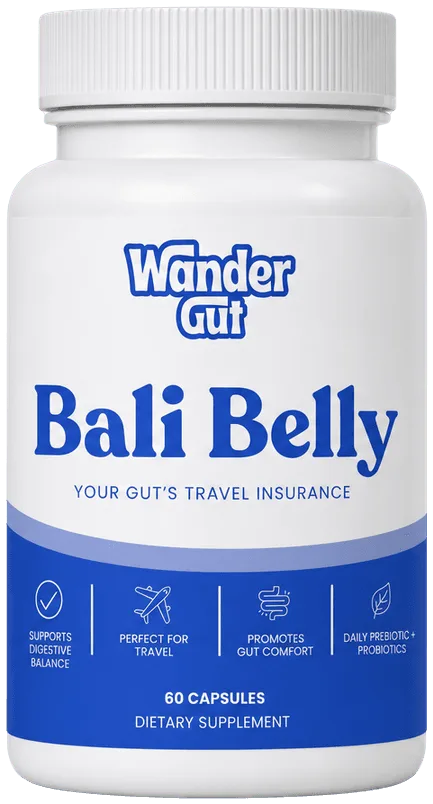
Bali Belly: the travel probiotic made for Bali and beyond
Your travel companion: 60 billion CFU, five strains plus a prebiotic, shelf-stable so it needs no fridge and lives in the day pack. Two capsules a day, from about a week before you fly and every day you are away. Suitable for adults and children over 3.
- 60 billion CFU
- 5 strains plus a prebiotic
- No fridge needed
- Ships from Australia
Always read the label and follow directions for use. Everything on this site is free and stays free: the guide, the tools, the checklists. The shop is what pays for it.
Sources and dates
- Smartraveller, Travel health, last updated 18 August 2026. Read 13 September 2026.
- Smartraveller, Taking medicine and medical devices overseas, last updated 18 August 2026. Read 13 September 2026.
- Smartraveller, Indonesia travel advice, updated 11 September 2026, still current on the day we read it. Read 13 September 2026.
- healthdirect, Travel health advice, last reviewed December 2025. Read 13 September 2026.
- healthdirect, Diarrhoea, last reviewed February 2024. Read 13 September 2026.
- healthdirect, Dehydration, last reviewed July 2024. Read 13 September 2026.
- healthdirect, Rabies, last reviewed March 2025. Read 13 September 2026.
- healthdirect, Sunburn and sun safety. Read 13 September 2026.
- The Wander Gut Bali guide, chapters on food, getting around, etiquette and gotchas, verified July 2026. Read 13 September 2026.
Left out on purpose because we could not verify it from a primary source: whether specific Australian brands are sold in Bali pharmacies; prices of anything; the Indonesian Embassy's own medication list, which we did not read on the day.