
The short answer
Smartraveller's Indonesia page lists no vaccination certificate as an entry requirement for Australians (read 13 September 2026). Beyond that, it is a doctor's decision made 6 to 12 weeks before you fly, starting with your routine vaccines and then weighing hepatitis A, typhoid, rabies and the others below.
healthdirect's timing is the one to write down: see your doctor at least 6 weeks and preferably 12 weeks before you leave, because some vaccines need more than one dose and your body needs time to respond. Smartraveller says 8 weeks. Either way, the fortnight before is too late for some of them.
The sections below are what the sources say, disease by disease, and nothing more. Your GP or a travel clinic weighs them against your age, your history, your itinerary and how long you are going.
When to see the doctor
healthdirect, unchanged:
You should see your doctor at least 6 weeks (and preferably 12 weeks) before you leave Australia. This will give your immune system time to respond to any vaccines you need. You may need more than one dose of some vaccines.
healthdirect says your doctor will consider your age, vaccination history, pregnancy, past and present illnesses, the season, your destinations, the length of stay and the type of travel. Smartraveller's general health page says 6 to 8 weeks and its medication page says at least 8 weeks, for the same reasons. Some pharmacies also offer travel health advice.
Bring your vaccination record. healthdirect notes that immunity to some diseases fades and you may need a booster even if you were vaccinated before.
Routine vaccines first
Both healthdirect and the Immunisation Handbook start with the vaccines you may already think of as done. healthdirect's routine list to keep up to date: measles, mumps and rubella; influenza; chickenpox; polio; diphtheria, tetanus and whooping cough.
The Handbook adds detail that surprises people. Measles: Australians born during or since 1966 who have not had two doses of a measles-containing vaccine are recommended to have MMR before travelling, and it notes that inadequately vaccinated young adults returning from overseas cause most measles outbreaks in Australia. Tetanus: for high-risk travel, consider a booster if more than five years have passed, especially where a wound is likely and care may be delayed. Influenza: the Handbook calls it the most common vaccine-preventable infection among travellers.
The food and water ones: hepatitis A, typhoid, cholera
The Immunisation Handbook says it is common for travellers to ingest contaminated food or beverages and that vaccines are available against hepatitis A, typhoid and cholera. Smartraveller's Indonesia page lists hepatitis A, typhoid and cholera among the food- and water-borne diseases that are widespread there. Whether you have any of them is the doctor's call; what you can do is know they are on the list.
Note what is not on any list: there is no vaccine for Bali belly itself. The Victorian Department of Health's fact sheet says there are currently no vaccines that reliably keep traveller's diarrhoea away and that the best defence is the food and water habits. Ask your doctor about the oral cholera vaccine if you want the fuller conversation; that is theirs to have.
Rabies and Japanese encephalitis
Rabies. Smartraveller says rabies is throughout Indonesia, is 100% fatal, and is mainly transmitted by dogs, cats, monkeys and bats; its first piece of advice is to get vaccinated prior to travel, and it warns that treatment may be limited and the vaccine is not available everywhere. healthdirect says to speak with your doctor if you are travelling to a country that has rabies, that the vaccine is very safe, and that for most people it has a cost. It also says the vaccine does not replace first aid: any bite or scratch still means soap and water for 15 minutes and a doctor straight away, vaccinated or not.
Japanese encephalitis. The Handbook says it occurs throughout much of Asia including eastern Indonesia, and Smartraveller reports it in people returning from Indonesia, including from Bali. A vaccine exists; whether a two-week resort holiday warrants it is exactly the kind of question the appointment is for.
Dengue, malaria and the ones without a jab
healthdirect says there is currently no vaccine for a first-time dengue infection and that the best way to avoid it is not being bitten. Smartraveller lists malaria as present in Indonesia and its general health page suggests asking your doctor about preventive medicines; the Handbook notes malaria is managed with barrier precautions and, where appropriate, medication rather than a vaccine. Zika is on Smartraveller's list too, which matters if you are pregnant or planning to be.
So for the mosquito-borne group the answer is mostly repellent, clothing and screens, on the staying healthy page, plus a malaria conversation with your doctor if your itinerary goes beyond the usual tourist areas.
Kids and pregnancy
Smartraveller says to check that children's childhood vaccinations are current and to ask about health issues that may affect them where you are going. The Handbook says all children should be vaccinated according to the National Immunisation Program schedule, and that infants 6 to 12 months old travelling to areas with measles outbreaks or where measles is endemic may be given MMR early.
For pregnancy, Smartraveller says to talk to your obstetrician about how to reduce risks, and the Handbook notes MMR is a live vaccine and is not given in pregnancy. healthdirect adds that pregnant women, babies, young children, older people and anyone with a weakened immune system have a higher risk of infection when travelling, which makes the appointment more important, not less.
What to take to the appointment, and what to take to Bali
- Your vaccination history, or as much as you can find; the Australian Immunisation Register is available through Medicare online.
- Your itinerary: where, how long, resort or rural, any island hopping, any scooter or trekking plans.
- Your regular medicines, because the same appointment is where you get the letter and the extra supply Smartraveller says to carry (the medical kit page covers the rules).
- Questions from this page: routine boosters, hepatitis A, typhoid, cholera, rabies, Japanese encephalitis, malaria for your itinerary, and anything specific to kids or pregnancy.
Keep a photo of the record you leave with. If you are ever bitten or scratched in Bali, the clinic will want to know whether you were vaccinated.
The questions people bring to the GP
Are vaccinations compulsory for Bali?
What vaccines do you need for Bali from Australia?
Do I need the rabies vaccine for Bali?
Is there a vaccine for Bali belly?
How long before Bali should I see the doctor?
Do kids need extra vaccines for Bali?
Do I need a dengue vaccine or malaria tablets for Bali?
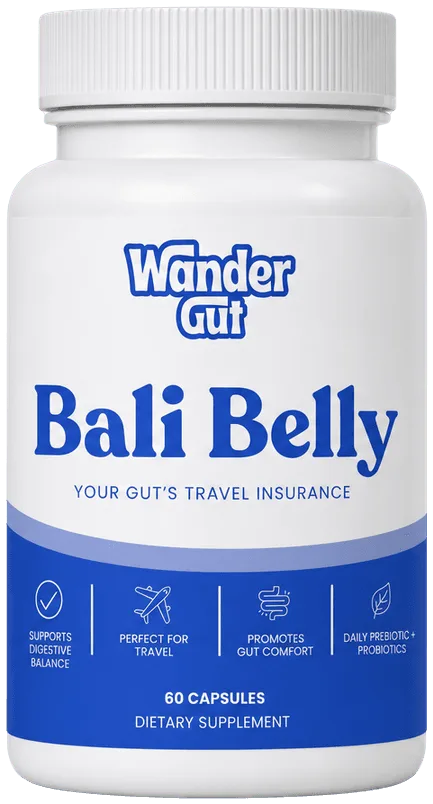
Bali Belly: the travel probiotic made for Bali and beyond
Your travel companion: 60 billion CFU, five strains plus a prebiotic, shelf-stable so it needs no fridge and lives in the day pack. Two capsules a day, from about a week before you fly and every day you are away. Suitable for adults and children over 3.
- 60 billion CFU
- 5 strains plus a prebiotic
- No fridge needed
- Ships from Australia
Always read the label and follow directions for use. Everything on this site is free and stays free: the guide, the tools, the checklists. The shop is what pays for it.
Sources and dates
- healthdirect, Travel vaccinations, last reviewed September 2025. Read 13 September 2026.
- The Australian Immunisation Handbook, Vaccination for international travellers. Read 13 September 2026.
- Smartraveller, Indonesia travel advice, updated 11 September 2026, still current on the day we read it. Read 13 September 2026.
- Smartraveller, Travel health, last updated 18 August 2026. Read 13 September 2026.
- healthdirect, Rabies, last reviewed March 2025. Read 13 September 2026.
- healthdirect, Dengue fever, last reviewed February 2025. Read 13 September 2026.
- Better Health Channel (Victorian Department of Health), Traveller's diarrhoea, the page states it was reviewed 31 July 2013; used for the causes and the risk-food list, which the newer sources repeat. Read 13 September 2026.
Left out on purpose because we could not verify it from a primary source: any recommendation of our own about which vaccines to have; vaccine prices; Indonesia's own entry-vaccination rules for travellers arriving from countries other than Australia.