
The short answer
Bali belly is not a single illness, so it is not contagious as such. But several of the things that cause it spread from person to person very easily, and norovirus, the worst of them for this, is described by healthdirect as highly contagious.
Treat any case in your group as catching until it is over. The practical rules: soap and water rather than hand gel, because alcohol sanitiser does not work on norovirus; nobody who is unwell prepares food or drinks for anybody else; and the Australian public health standard of 48 hours after the last episode before normal life resumes.
The other possibility is that nobody caught anything from anybody. If you all ate the same thing, you may simply all have the same exposure arriving at different speeds. Either way the response is identical, so it is not worth arguing about at 3am.
Why the answer is it depends
Bali belly is a nickname covering a whole family of infections, and they behave very differently. Some spread person to person readily. Some barely do at all and need the contaminated food or water to make the trip themselves.
Viruses are the contagious end. Norovirus and rotavirus move between people with very little help. Bacteria such as Salmonella, Campylobacter and E. coli mostly arrive via food and water, though poor hand hygiene will carry them from one person to the next. Parasites like Giardia spread through faeces reaching a mouth, which happens more easily than anyone likes to think about.
Since you will almost never know which one you have, and a stool test takes days you do not have on holiday, the sensible move is to assume the worst case and behave accordingly for a couple of days.
Norovirus, the one that takes out a whole villa
If four people go down within about 48 hours of each other, norovirus is the usual explanation. healthdirect does not hedge about it.
It is highly contagious. This means it spreads easily from person to person.
It spreads through contact with an infected person's faeces and through contaminated airborne droplets, which is the part people miss: vomiting puts virus into the air of a small bathroom, and the next person in does not need to touch anything to be exposed.
Symptoms typically start within 1 to 2 days of exposure and resolve within 1 to 3 days. And the single most useful sentence in this entire article, because it contradicts what every traveller instinctively reaches for:
Alcohol-based hand sanitisers do not kill norovirus, so use soap and water.
The bottle of hand gel in your day pack is not useless, it is just not the right tool here. Soap and running water, for twenty seconds, is.
How long is someone contagious?
Longer than they feel unwell, which is the trap. People go back to the pool bar the moment they feel human again and restart the chain.
The Australian public health rule for gastroenteritis is clear and it is the number to use:
Children and adults should not return to school or work until 48 hours after the last episode of diarrhoea and or vomiting.
For norovirus specifically, healthdirect advises avoiding preparing food for others for at least 2 days after symptoms stop, and healthcare workers are told to stay away for 48 to 72 hours. For giardiasis the exclusion is shorter, until there has been no diarrhoea for at least 24 hours.
On a holiday nobody is going to sit out 48 hours of Bali in a room, and pretending otherwise is useless advice. The workable version: the unwell person does not handle anyone else's food, drinks or ice for two days after they stop, and everyone washes their hands properly. That gets you most of the benefit without writing off half the trip.
The rules that actually work in a shared villa
- Soap and water, not gel. Twenty seconds, before anyone eats or handles food, and after every bathroom trip.
- One bathroom for the unwell person if the villa has more than one. If it does not, they flush with the lid down and wipe the taps and handle afterwards.
- Nobody sick touches shared food. No serving, no scooping ice, no passing around the fruit plate, no sharing a water bottle.
- Own towel, own bottle, own glass. Label them if you have to. This is where it usually goes wrong.
- Wash the sheets and towels hot if someone has vomited, and wash your hands after handling them.
- Tell the villa staff. They would much rather know and clean properly than find out later, and they deal with this constantly.
None of this is Bali specific. It is the same advice healthdirect gives for gastro in an Australian household, which is the point: this is an ordinary infection in an unfamiliar place.
Or did you all just eat the same thing?
Worth considering before anyone is blamed. If your group ate together and people start going down within a similar window, a shared source is at least as likely as person to person spread. Different people have different incubation periods and different amounts of the same bug, so identical exposure can look like a chain of infection.
You will probably never know. The Better Health Channel notes that a cause is never identified in roughly a fifth to half of all cases of traveller's diarrhoea, and holiday cases are almost never investigated at all because everyone is better before the result would come back.
It does not change what you do. Fluids, hygiene, and a doctor if the red flags on the main Bali belly page show up.
With kids, and who to worry about
Children are the most efficient spreaders in any household and the most vulnerable to dehydration, which is an unhappy combination. Nappies, hands and mouths do most of the work, and a toddler cannot be reasoned with about hand washing.
The thresholds are lower for them. healthdirect is explicit that anti-diarrhoeal medicines should not be used to treat diarrhoea in children, so rehydration is the whole plan, and a doctor sooner rather than later. The advice for travelling with children generally is on Bali with kids, including the water rules for bottles and formula.
The same caution applies to older travellers, anyone pregnant, and anyone managing a medical condition or taking medication that affects the gut. In those cases the wait-and-see window is much shorter and a clinic visit is a reasonable first move rather than a last one.
What people ask when someone in the villa goes down
Is Bali belly contagious?
How long is Bali belly contagious for?
Can Bali belly spread between people in the same villa?
Does hand sanitiser stop it spreading?
We all got sick at once. Did we give it to each other?
Can you catch Bali belly from a swimming pool?
Is it contagious before symptoms start?
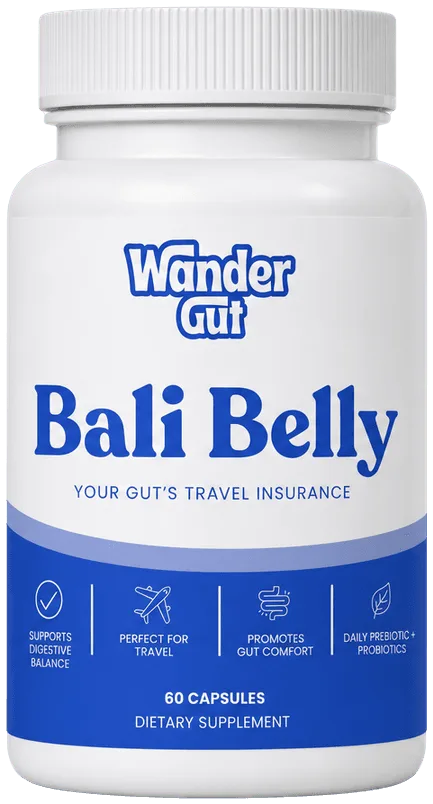
Bali Belly: the travel probiotic made for Bali and beyond
Your travel companion: 60 billion CFU, five strains plus a prebiotic, shelf-stable so it needs no fridge and lives in the day pack. Two capsules a day, from about a week before you fly and every day you are away. Suitable for adults and children over 3.
- 60 billion CFU
- 5 strains plus a prebiotic
- No fridge needed
- Ships from Australia
Always read the label and follow directions for use. Everything on this site is free and stays free: the guide, the tools, the checklists. The shop is what pays for it.
Sources and dates
- healthdirect, Norovirus infection. Read 14 September 2026.
- healthdirect, Gastroenteritis. Read 14 September 2026.
- healthdirect, Giardiasis. Read 14 September 2026.
- healthdirect, Diarrhoea: symptoms, causes, self care and treatments. Read 14 September 2026.
- Better Health Channel (Victorian Department of Health), Travellers' diarrhoea. Read 14 September 2026.
Left out on purpose because we could not verify it from a primary source: any figure for how often Bali belly spreads between travellers, because no study measures it; the specific organism behind any individual case, which is almost never tested on a holiday.