
The short answer
Bali spending money splits three ways: cash for warungs, drivers, scooters and massages; card or QR for cafés, coffees and bars; and the e-VOA and tourist levy paid online before you fly. The calculator totals the guide's July 2026 ballparks for the trip you describe, at the RBA rate.
The guide's mental shortcut is IDR 10,000 to A$1. The real rate on 11 September 2026 was 12,633 rupiah to the dollar, so the shortcut overstates prices by roughly a quarter, which is the right direction to be wrong in. A 25k nasi goreng is about two dollars; a 900k private driver for the day, split four ways, is about eighteen dollars each.
Take a small stash out at an airport ATM attached to a real bank, then withdraw in a few goes rather than carrying a fortnight's cash on day one. Warungs, drivers, parking attendants and markets are cash; most cafés and minimarts take cards and QR payments; the visa and the levy are paid online at home. The sections below have the government's lines on ATMs, money changers and the cash declaration limit.
The mental shortcut and the real rate
IDR 10,000 is about A$1 is the guide's rule for reading a menu without a calculator: knock four zeros off. On 11 September 2026 the Reserve Bank's published rate was 12,633 rupiah per Australian dollar, so the shortcut makes everything look about a quarter dearer than it is. That is a feature. Rounding the wrong way at a market costs you a dollar; rounding the wrong way on a two-week budget costs you a holiday.
The calculator uses the RBA figure, dated, and prints both currencies. Street exchange rates in Bali are a different number again, and the ones that look too good are the ones Smartraveller warns about below.
Warung feed
IDR 20-40k, about $2-4. Cooked hot and fresh, locals in plastic chairs, and the best value on the island.
Barista coffee
IDR 30-50k, $3-5. Bali's café scene prices like Melbourne's, in the good spots.
One-hour massage
IDR 100-200k, $10-20. The afternoon activity the guide's rhythm tip is built around.
Private driver, full day
IDR 600-900k, $55-85, split between the group. Door to door, your villa host will have a guy.
Ballparks from the guide's money board, July 2026. Tourist-strip venues charge more; the calculator's high figure is the honest end of the range.
Cash or card in Bali?
Both, in a fixed pattern. The guide's line: Bali is increasingly cashless, with cards and QR payments working in most cafés and minimarts, but warungs, drivers and small shops still run on cash, so carry a few hundred thousand rupiah broken into small notes. Ride apps quote the price in the app and the guide notes that the in-app price ends the haggling; whether you pay the driver in cash or through the app, the calculator counts rides as cash, because most people do.
The calculator's 'carry as cash' figure is the warung meals, drivers, scooters, massages, airport rides and your own buffer. 'Fine on card' is cafés, coffees and bars. If you would rather pay cafés in cash too, the total does not change; only the split does.
ATMs: which ones, and the 'no conversion' button
Smartraveller's guidance on cards and ATMs in Indonesia is specific enough to quote whole:
Credit card, online banking and ATM fraud occurs. Tell your bank you're going to Indonesia before you travel. Ensure your phone number and bank accounts work overseas. Never let your card out of your sight. Cover your PIN when you use it. Some vendors, including at ATMs, install hidden cameras and use card skimmers. Use authorised ATMs in safe places, like at a bank branch, shops or shopping centres.
The guide adds two habits: use machines attached to real banks, and if the machine offers to convert the withdrawal to Australian dollars, pick 'no conversion', because the conversion is the machine's rate, not your bank's. We could not source ATM fees or per-withdrawal limits from anything we would cite, so they are on the dropped list below; withdrawing in a few goes is the sensible middle either way.
Money changers: the authorised ones only
Smartraveller's money section for Indonesia, in full, including the cash declaration rule people forget:
The local currency is the Indonesian Rupiah (IDR). Only exchange money at authorised money changers. Unauthorised money changers have been known to scam foreign tourists in Bali and elsewhere. Declare cash in excess of IDR 100,000,000 or equivalent when you arrive and leave. This covers all forms of currency, not only cash.
Smartraveller links to a list of authorised money changers, and the guide's version of the same rule is the signage: use banks, airport counters or changers showing 'PVA Berizin', never the too-good-to-be-true street rates. The guide's other line is the one that matters in the moment: count your notes yourself, on the counter, before you walk away. The money-changer sleight of hand is the first item on the guide's gotcha list for a reason.
The IDR 100,000,000 declaration limit is about A$7,900 at the RBA rate, which nobody on a holiday is carrying, but it covers all forms of currency and applies on the way out too.
Haggling, and the prices that are not printed
The guide's rule: haggling belongs in markets and with street vendors, not in shops with price tags. Smile, counter at about half, meet in the middle, and let 10,000 rupiah go, because it is a dollar. Anything unpriced has a tourist price, which is why ride apps and a smile fix most of it. Tipping customs are not something we could source to a standard we would print, so they are on the dropped list rather than invented here.
What the calculator leaves out
- Accommodation and flights. No sourced figure, so no line. Add your own on top.
- Entry fees, tours and the Mount Batur guide. They exist and they vary; the buffer line is where they go.
- Tips. No source we would print. Buffer.
- Shopping. The guide's advice is an empty corner of the bag; the market will fill it, at whatever you agree to.
- Beach-club day beds. Priced as a minimum spend, which the guide lists as 'varies', so the calculator does not pretend.
Money questions people ask
How much spending money do I need for Bali for 7 days?
How much cash should I take to Bali for 2 weeks?
Should I take Australian dollars to Bali or use ATMs?
Can I use my card in Bali?
Do you tip in Bali?
How much is IDR 100,000 in Australian dollars?
Is the Bali tourist levy paid in cash?
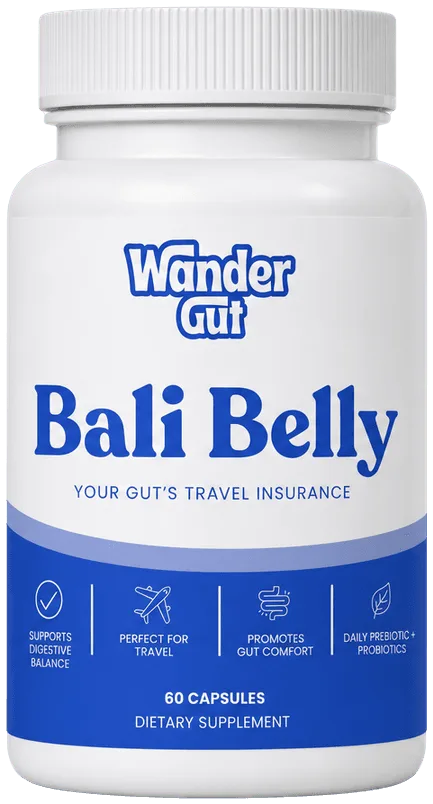
Bali Belly: the travel probiotic made for Bali and beyond
Your travel companion: 60 billion CFU, five strains plus a prebiotic, shelf-stable so it needs no fridge and lives in the day pack. Two capsules a day, from about a week before you fly and every day you are away. Suitable for adults and children over 3.
- 60 billion CFU
- 5 strains plus a prebiotic
- No fridge needed
- Ships from Australia
Always read the label and follow directions for use. Everything on this site is free and stays free: the guide, the tools, the checklists. The shop is what pays for it.
Sources and dates
- Reserve Bank of Australia, exchange rates (units of foreign currency per Australian dollar), Indonesian rupiah 12,633 per A$1 on 11 September 2026. Read 13 September 2026.
- The Wander Gut Bali guide, chapters on money, getting around, where to base yourself, food, the bucket list and the gotchas, verified July 2026. Read 13 September 2026.
- Smartraveller, Indonesia travel advice, updated 11 September 2026, still current on the day we read it. Read 13 September 2026.
- Love Bali, the Bali provincial government's tourist levy site, levy amount. Read 13 September 2026.
- Directorate General of Immigration, official e-Visa site, the only place to buy an e-VOA; the price used here was read there in July 2026. Read 2 July 2026.
Left out on purpose because we could not verify it from a primary source: ATM withdrawal fees and limits; tipping customs; accommodation and flight prices; café and restaurant meal prices (the calculator leaves that line for you); entry fees and tour prices.